
Smith County Warrant Fallback Channels
No official Smith County online active warrant list, warrant search portal, most-wanted list, or Smith County, Kansas sheriff app is available from the official county sources. That absence changes the order of work. A Smith County warrant search should begin with the office most likely to know current custody and service status, then move to the court file, the statewide public case search, and municipal or city police channels when the ticket or ordinance case started there.
The Smith County Sheriff's Office and jail are the direct local law-enforcement channel for arrest-warrant and jail-hold questions. The office is at 217 S. Jefferson St., Smith Center, KS 66967, and the phone number is 785-282-5180. The Smith County District Court can address public court events, bond orders, dates, and warrant-related docket entries at 218 S Grant St., PO Box 273, Smith Center, KS 66967, phone 785-282-5140. Use Kansas CaseSearch for public District Court case information when a name, case number, or citation is known.
Municipal matters need a separate check. The Smith Center Municipal Court gives 785-282-3249 for court schedule information, and municipal bench warrants for missed city ordinance or traffic settings may not appear the same way as District Court criminal cases. The Smith Center Police Department, Chief Jamie Marshall, is at 117 1/2 W. Court, Smith Center, KS 66967, phone 785-282-6555, email scpd@ruraltel.net.
The official Smith County Sheriff page is the local source for sheriff office contact details.
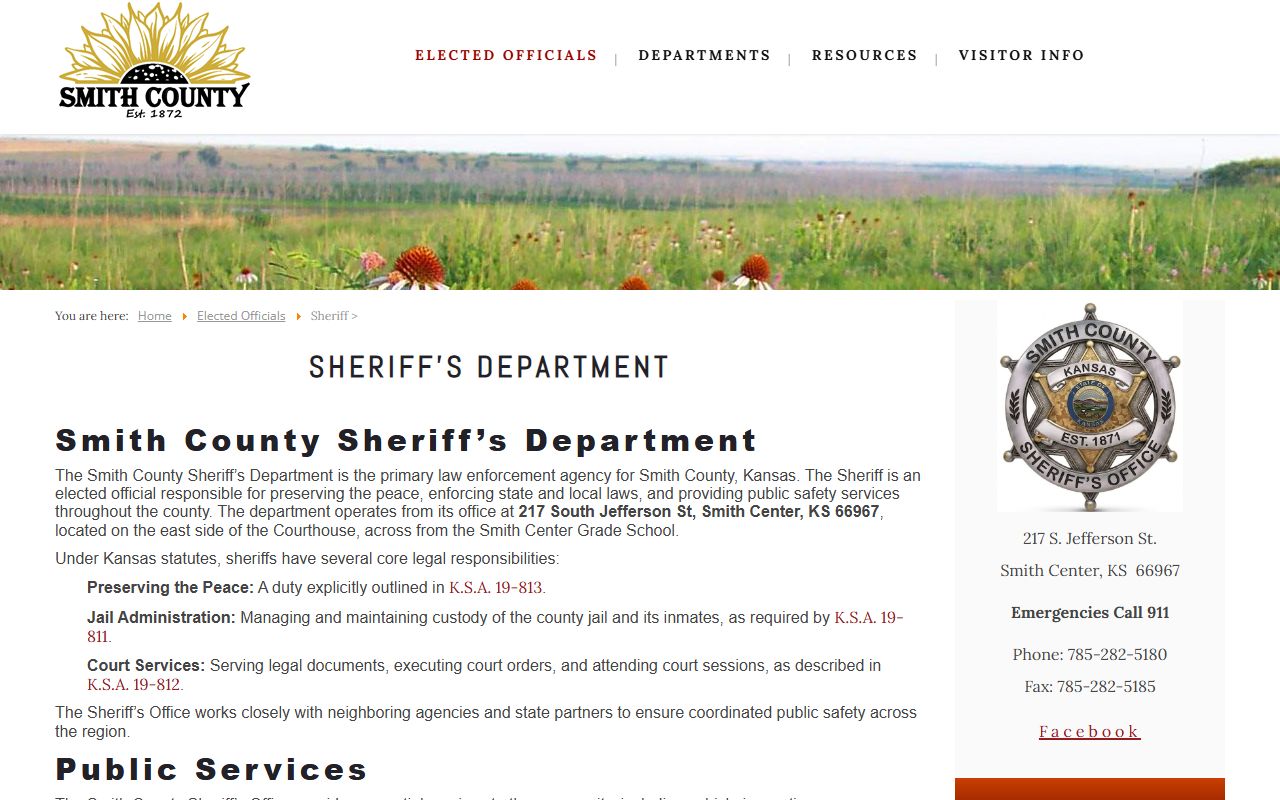
That sheriff channel matters because current warrant service, jail holds, and bond logistics can change faster than public case-search information.
Smith County Warrant Types
Smith County warrant records may come from different legal events. An arrest warrant is usually tied to a complaint or a probable-cause finding. A bench warrant is commonly issued after a missed court date, a failure to comply with an order, contempt, a probation issue, or an unpaid obligation that has not been cleared through the court. A search warrant is different. It authorizes a search of a person, place, or property, and the public file may be sealed while an investigation is active.
- Arrest warrant - A judicial order authorizing arrest, often after a complaint, citation, or probable-cause review.
- Bench warrant - A judge-issued warrant often linked to failure to appear, contempt, unpaid obligations, or a probation matter.
- Search warrant - An order allowing a search, often restricted while the investigation or return remains active.
- Probation or parole hold - A supervision-related custody order, with KDOC information relevant for post-sentence supervision.
- Fugitive warrant - An outside jurisdiction warrant that may produce a Smith County hold or extradition issue.
The Kansas Sheriffs' Association Smith County entry also confirms the sheriff office contact information used for local warrant follow-up.
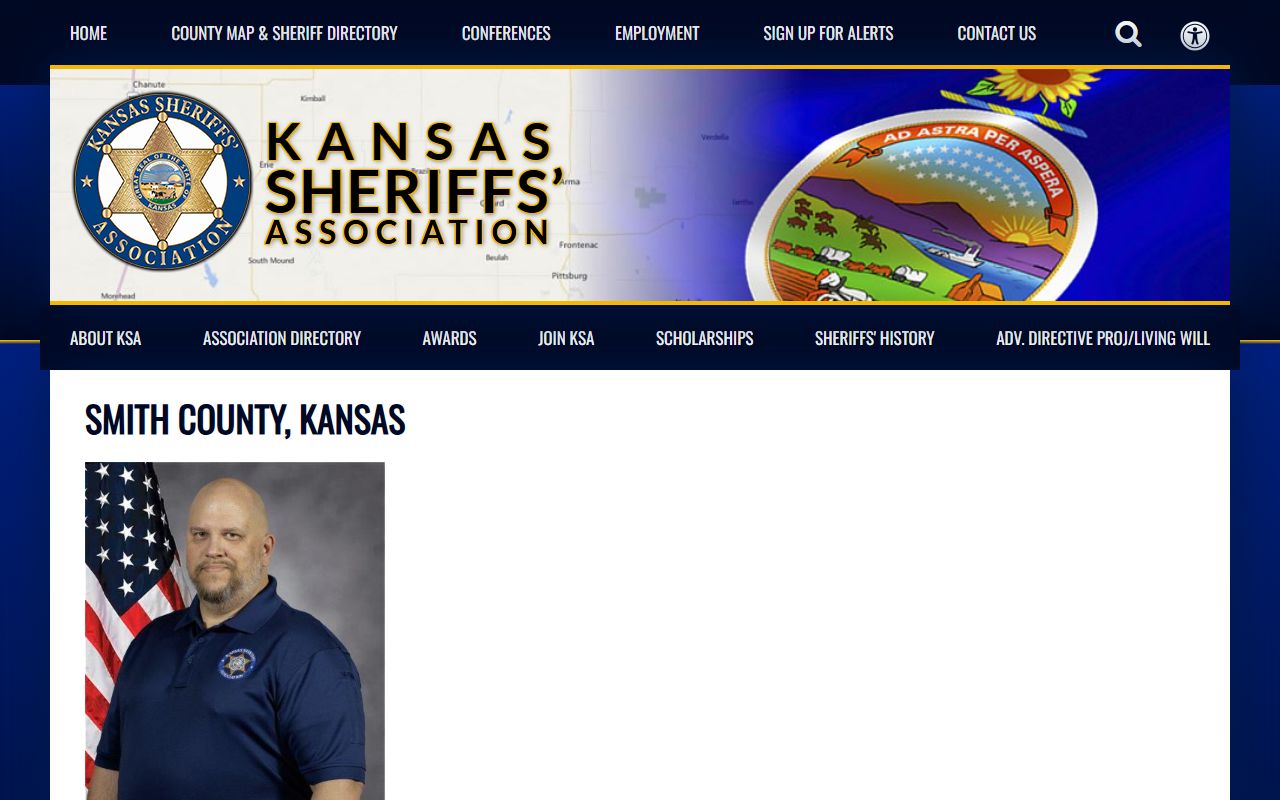
Directory confirmation is useful when a warrant question requires direct contact rather than a public search result.
How to Search Smith County Warrants
Because Smith County does not publish an active warrant roster, the best search path starts by identifying the likely court level. A state-law criminal, traffic, fish-and-game, domestic, probation, or felony matter usually belongs with District Court. A city ordinance or municipal traffic matter may belong with Smith Center Municipal Court. If a person may already be in custody, the jail phone path is the most direct route.
- Call the Smith County Sheriff's Office or jail at 785-282-5180 for current custody, jail-hold, and bond logistics tied to a possible local warrant.
- Call Smith County District Court at 785-282-5140 for public case events, court dates, bond orders, and warrant-related docket entries.
- Search Kansas CaseSearch by case number, party name, business name, or citation when the underlying case is a District Court matter.
- Call Smith Center Municipal Court at 785-282-3249 when the issue started as a city ordinance or municipal traffic case.
- Use the Smith Center Police Department contact only for city law-enforcement questions, not as a substitute for court confirmation.
- Use the Smith County open-records request process for non-court sheriff or county records, while recognizing that investigative or active warrant details may be withheld.
Note: A missing online result does not prove that no Smith County warrant exists.
Smith County Warrant Search Fields
Smith County does not publish a sheriff warrant-search form. The practical field set is therefore a fallback inventory of the information each official channel may ask for when checking the court file, a municipal setting, or a public CaseSearch result. Exact identifiers reduce false matches, especially when a name is common or a citation moved from a ticket to a court case.
| Field Label | Type | Required | Notes |
|---|---|---|---|
| Full legal name | Text | Usually | Needed for sheriff, jail, court, and CaseSearch name checks. |
| Date of birth | Date | Often | Helps distinguish people with similar names when staff can use it. |
| Case number | Text | No | Best for District Court questions and Kansas CaseSearch. |
| Citation number | Text | No | Useful for traffic, fish-and-game, or municipal matters. |
| Issuing court | Choice | No | Separates District Court from Smith Center Municipal Court. |
| Charge or event | Text | No | May identify failure to appear, probation, contempt, or bond issues. |
What Smith County Warrant Records Show
No official sample Smith County warrant record is published with a field-by-field local example. When a warrant event is public, the visible fields are likely to come from the public District Court case record, municipal case record, or court staff response. A public entry may show the warrant as one event in a larger case, rather than as a stand-alone warrant record.
| Field | What It Shows |
|---|---|
| Defendant name | The person tied to the public case or warrant event. |
| Case number | The District Court or municipal case identifier connected to the warrant. |
| Issuing court | Whether the matter belongs to Smith County District Court or Smith Center Municipal Court. |
| Warrant date | The date the warrant was issued or entered on the docket, if public. |
| Warrant type | Arrest, bench, failure to appear, probation, parole, or search warrant if visible. |
| Charge or offense | The alleged offense, missed hearing, or case event that led to the warrant. |
| Bond amount or type | Cash, surety, own recognizance, or other bond information if released by the court. |
| Recall or quash date | The date the court cleared, recalled, or canceled the warrant, if entered publicly. |
Restricted Smith County Warrant Records
Kansas has a key limit for public warrant searches. K.S.A. 60-2617 allows certain sealing, redaction, and closed proceeding rules, and a criminal or juvenile case in which an arrest warrant is sought is sealed until the warrant is executed or the request is denied. That means an unserved warrant may not appear in public case search even when a court file exists behind the scenes.
Other limits can apply. Juvenile matters, protected victim or witness information, active criminal investigative records, sealed documents, and some search-warrant materials may be restricted by statute, court rule, court order, or Kansas public-record exemptions. For that reason, Smith County warrant records should not be judged only by public web results. The more current question is whether the issuing court or sheriff can confirm what may be disclosed.
Important: Do not rely on third-party warrant sites or unofficial payment requests when court or sheriff confirmation is available.
Resolving Smith County Warrants
Anyone who learns about a possible Smith County warrant should use official channels before making payments or assuming the warrant is clear. District Court staff or municipal court staff can tell a person what public case steps exist, whether a court appearance is required, and how bond or recall instructions are handled. The Sheriff's Office can address custody and bond logistics if the court directs a person there. Legal advice should come from an attorney, not from court or jail staff.
- Confirm the issuing court before acting on a result.
- Ask the District Court or Municipal Court about warrant status, bond, next court date, and recall procedure.
- Contact the Sheriff's Office for custody or bond logistics if court staff directs that step.
- Pay or clear obligations only through official court or sheriff channels.
- After resolution, ask when the recall or clearance will be entered and when public systems may update.
The Smith Center Municipal Court page is the city source for municipal court schedule contact information.
Municipal court contact is especially important when the warrant question started with a city citation or ordinance violation.