
Smith County Clerk Records Office
Smith County court records are maintained through the Clerk of the District Court. The Kansas Judicial Branch 17th Judicial District listing places Smith County District Court at the Smith County Courthouse in Smith Center and gives the local District Court phone number. Search-result text from the official district page associated Shannon Schmidt with Smith County and also showed Lauren Schmidt as Clerk of the District Court for the district page, so naming a single current clerk from the research would risk overstatement. The reliable contact point is the Smith County District Court clerk office.
The Clerk of the District Court is distinct from the Smith County Clerk and from the Register of Deeds. The court clerk handles court case records. The County Clerk is a county administrative, election, payroll, tax-roll, licensing, and commission-record office. The Register of Deeds records and indexes land records and related instruments. Sending a request to the wrong office can delay the search because each office controls a different set of records.
Clerk of the District Court
Office: Smith County District Court
218 S Grant St., PO Box 273
Smith Center, KS 66967
785-282-5140
Call for current District Court clerk hours, copy procedures, and certified-copy instructions.
Smith County Clerk Office Differences
The official Smith County Clerk page names Ashley Maxwell as County Clerk and describes duties that are not the same as District Court case work. The County Clerk serves as secretary to the Board of County Commissioners, processes accounts payable and payroll, prepares financial reports, keeps personnel files and county policies, calculates levies, creates tax rolls, issues fish and game licenses and boat registrations, and handles solid-waste billing and collection. The County Clerk page also says people who want to be placed on the county commission agenda must contact that office by the Friday before a Monday meeting.
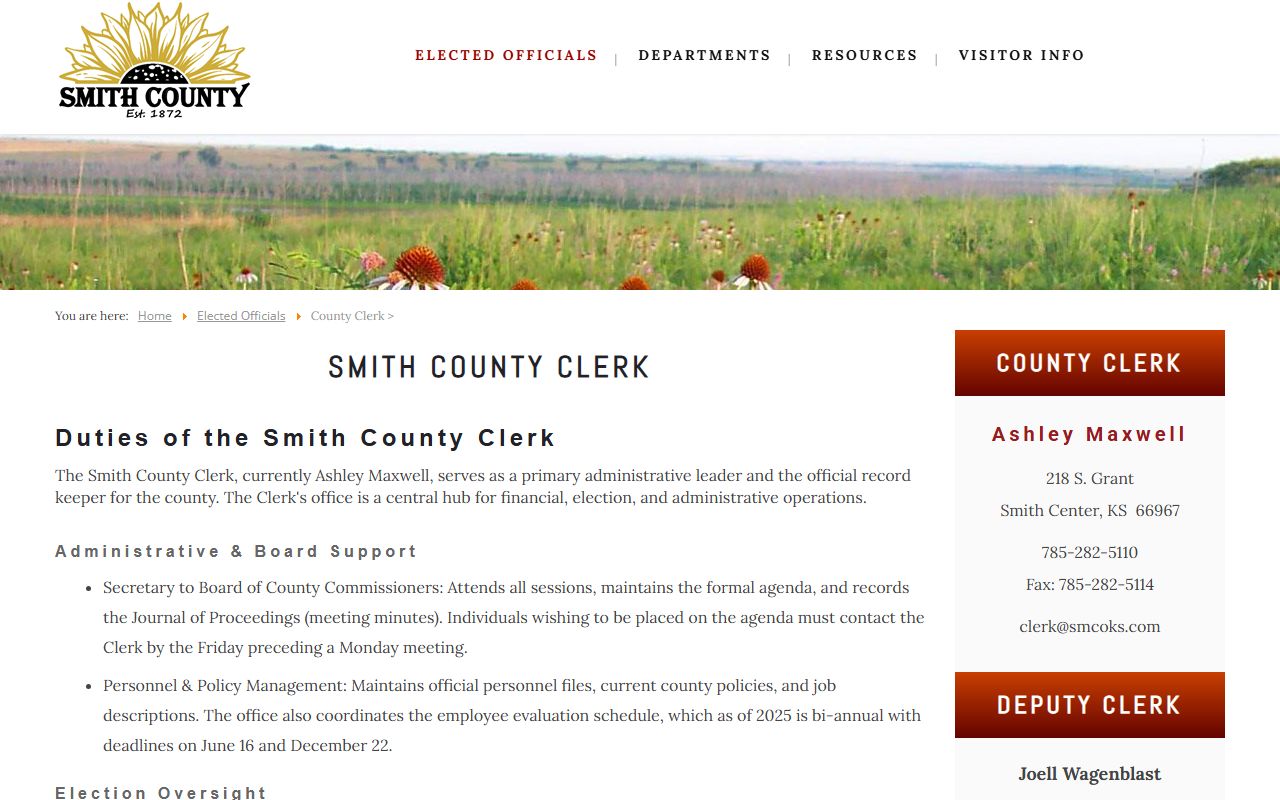
The County Clerk is important for county records, but District Court cases should first be routed through Kansas CaseSearch or the Clerk of the District Court.
The Register of Deeds is another separate office. The official Smith County Register of Deeds page names Stephanie Arment and lists the office at 218 S. Grant, Suite #7, phone 785-282-5160, email smithcorod@gmail.com. Posted hours are Monday through Friday from 8:00 a.m. to 5:00 p.m., closed noon to 1:00 p.m. for lunch. That office accepts, indexes, copies, and preserves deeds, mortgages, leases, liens, mechanic's liens, tax liens, UCC filings, military discharges for safekeeping, and archive records used by title searchers, genealogists, and surveyors.
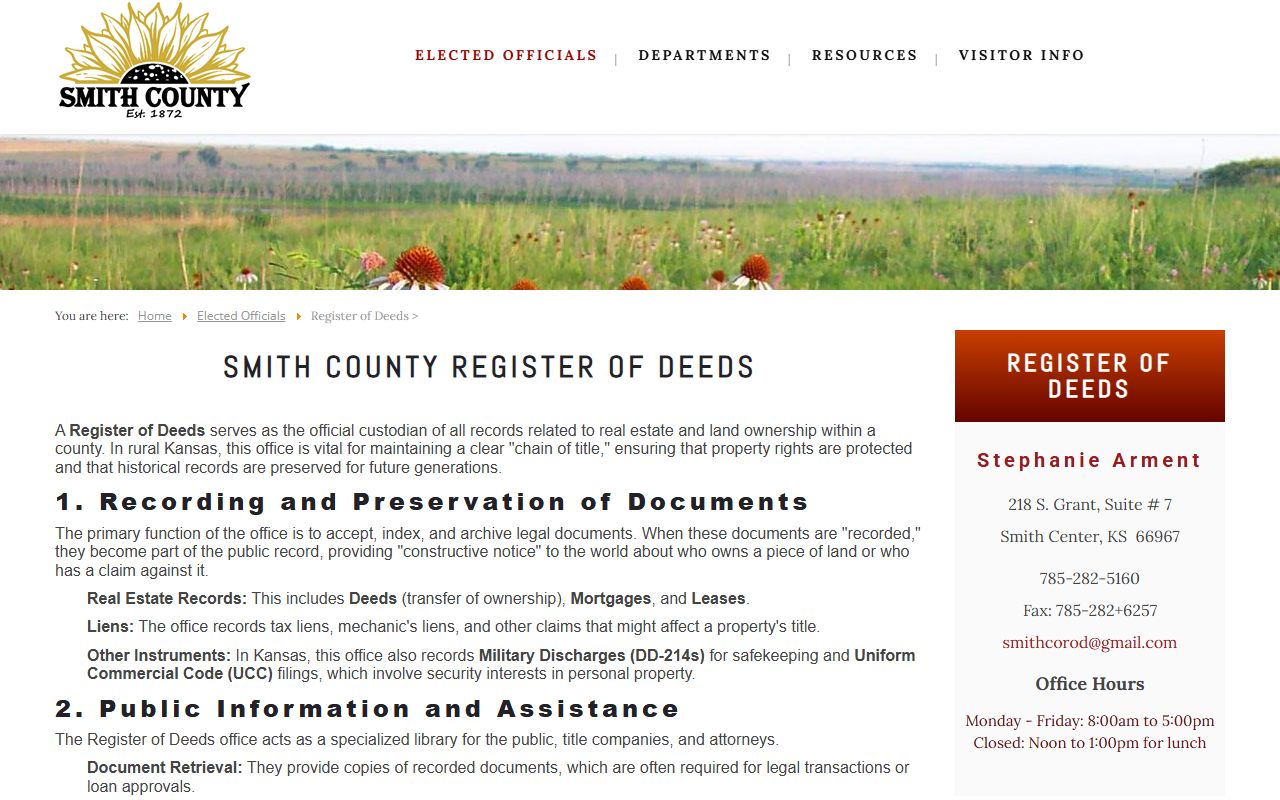
Land records and court records can intersect after a probate, divorce decree, judgment lien, or release, but the court case file and recorded land instrument remain separate records.
Request Smith County Certified Copies
Certified copies are usually needed when a court document must prove an official court action. Examples include a divorce decree, probate order, judgment, disposition, or other filed order. Start with the case number if known. If the number is not known, gather the party names, case type, approximate filing year, and the exact document needed before calling the Clerk of the District Court.
- Search Kansas CaseSearch or gather the case number, party names, case type, and filing year from personal records.
- Call the Clerk of the District Court at 785-282-5140 to ask whether the document is available, public, certified locally, or restricted.
- Confirm the total copy and certification cost before mailing a request or visiting the courthouse.
- Provide a mailing address, phone number, and enough document detail for the clerk to identify the file.
- Use the County Clerk open-records form only for county-held administrative records, not as the first route for District Court case documents.
Certified-copy fees for Smith County District Court were not located in the official local research. The safest path is to confirm the current amount with the Clerk of the District Court before payment.
Smith County Request Form Fields
Smith County maintains an official open-records request channel under the County Clerk for county-held records. The Smith County open records page links a Request for Record Inspection or Copy form and posts the county fee schedule. This form is a fallback for county administrative records, not a substitute for a District Court file request when the record is a case filing.
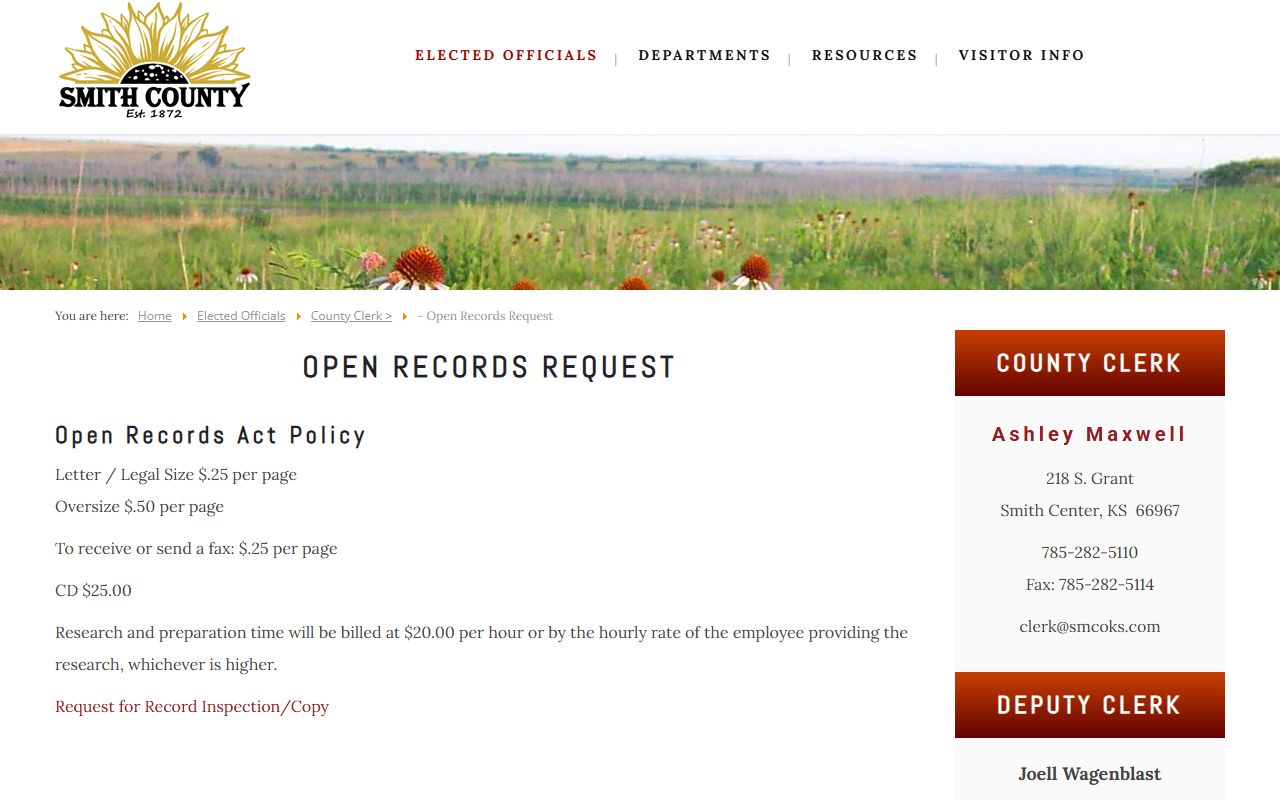
The posted county open-records policy is still useful because it shows the county's documented form fields and cost structure for non-court records.
| Field | Who completes it | Notes |
|---|---|---|
| Name and address | Requester | Identifies the person asking to inspect or copy records. |
| Noncommercial list-use certification | Requester | Certifies that name and address lists will not be used for sale, solicitation, gifts, donations, or transfer for those purposes. |
| Signature | Requester | Certifies the requester's statement. |
| Record(s) sought | Requester | Should include record titles, dates, and the county office or department that produced or holds the record. |
| Number of copies | Requester | Used when copies are requested instead of inspection only. |
| Charges estimated and staff time | County staff | County staff estimate cost, staff time, copy charges, and total charges due. |
| Time received and records provided | County staff | Tracks receipt, response, custodian, and release details. |
Smith County Clerk Fees
Smith County's posted open-records charges apply to county-held administrative records requested through the County Clerk channel. The form says payment must be received on the day of request, and the charges are set to compensate the county for actual costs incurred. These amounts should not be treated as District Court filing fees or certified court-copy fees unless the court clerk confirms the same amount applies.
| County open-records item | Amount |
|---|---|
| Letter or legal size copies | $0.25 per page |
| Oversize copies | $0.50 per page |
| Receiving or sending fax | $0.25 per page |
| CD | $25.00 |
| Research and preparation time | $20.00 per hour or the employee's hourly rate if higher |
The Register of Deeds has its own fee schedule for recording and certified land copies. The official Register of Deeds fee schedule lists deed and mortgage recording, UCC filings, liens, copies, and certification charges.
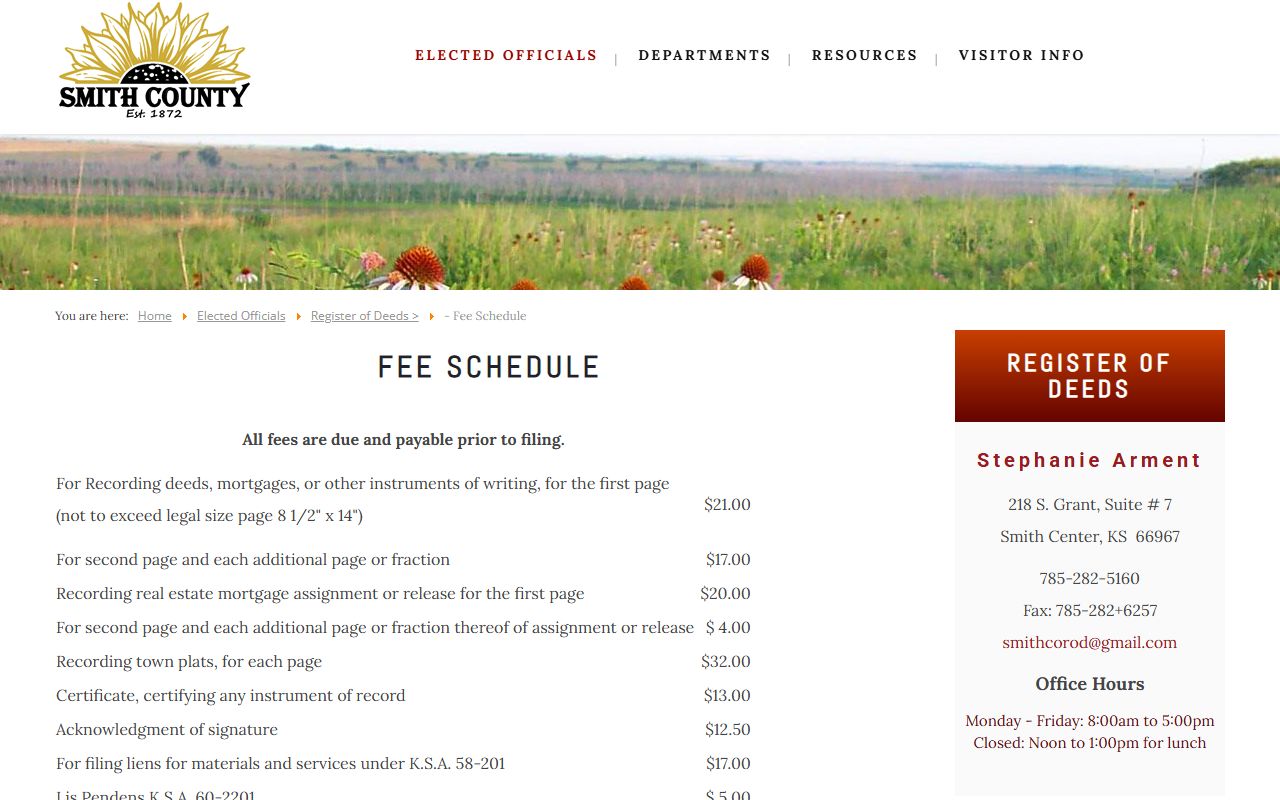
That separate schedule matters when a court order leads to a recorded deed, lien, release, or other land instrument.
Smith County Clerk Record Routing
The fastest request is the one sent to the office that actually holds the record. Court case documents should go to the Clerk of the District Court. County commission, election, payroll, tax-roll, license, and administrative records should go to the County Clerk. Deeds, mortgages, liens, UCC filings, military discharge safekeeping records, and recorded copies should go to the Register of Deeds.
| Record needed | Start with | Why |
|---|---|---|
| Criminal, civil, divorce, probate, small claims, or juvenile case file | Clerk of the District Court | These are District Court records. |
| Certified divorce decree or probate order | Clerk of the District Court | The certification must come from the court file. |
| County commission agenda or county administrative record | County Clerk | The County Clerk serves county administrative and commission functions. |
| Tax-roll ownership or levy records | County Clerk | The County Clerk maintains real-estate files and tax-roll work. |
| Recorded deed, mortgage, lien, release, or UCC filing | Register of Deeds | The Register of Deeds records and indexes land instruments. |
Smith County Court Record Access
Online public District Court information is searched through Kansas CaseSearch. Courthouse inspection and copy questions go to Smith County District Court. The county website does not publish a separate Smith County court-record database, and the County Clerk's open-records form should not be used to bypass court rules for sealed, restricted, certified, or case-specific documents.
Public access is also limited by the type of file. Juvenile, adoption, care-and-treatment, mental health, protected personal identifier, and sealed records may not be released to the general public. When a record is restricted, the clerk may be able to explain the request path, but release may require party status, attorney status, statutory authority, or a court order.
For a clean request, state the court level first. Smith County District Court records go to the Clerk of the District Court, city ordinance matters may belong with Smith Center Municipal Court, and non-court county records follow the county open-records process. That first sorting step prevents a court document request from being treated like a county administrative record.