
Smith County Probate Records Overview
Probate in Smith County is handled through the probate jurisdiction of the Kansas District Court. That means estate and guardianship cases are not filed with a stand-alone probate court, and there is no separate Smith County probate clerk office located in the official sources used for this build. The Probate Division of the District Court is part of Smith County District Court, which sits in the 17th Judicial District with Decatur, Graham, Norton, Osborne, and Phillips counties.
Smith County probate records may include wills, estate petitions, petitions for administration, orders admitting a will, appointment papers for an executor or administrator, inventories, creditor notices, accountings, final settlement records, trust-related filings, minor estates, adult guardianships, conservatorships, and related hearing entries. Public access can change by record type. Routine estate filings may be public, while guardianship, conservatorship, medical, mental-capacity, minor, or sealed materials may be restricted or redacted.
The official Kansas Judicial Branch probate self-help material is a useful starting point for statewide probate topics. The Kansas probate and elder law page explains the broader court context that applies before a Smith County filing reaches the local clerk.
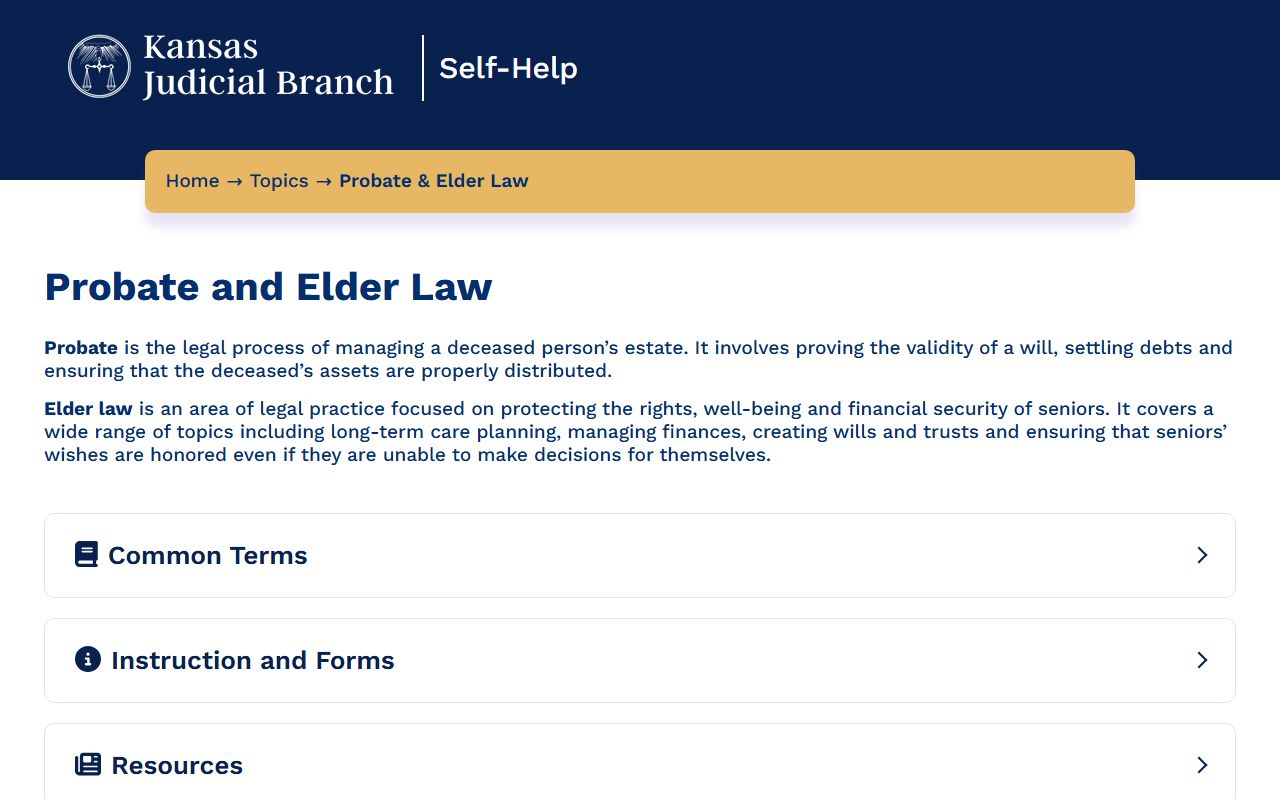
That state resource supports the local point: Smith County probate matters are court filings, not county administrative files, and they should be routed to District Court unless the issue is a later deed, tax-roll, or land-record update.
Smith County Probate Court Contact
For Smith County probate record questions, use the District Court contact path. The Clerk of the District Court is the local office for probate file inspection, copy requests, certified copies, older or non-digitized files, and questions about whether a will, estate, guardianship, or conservatorship case is filed locally. The County Clerk may see ownership transfer paperwork after probate, and the Register of Deeds may record deeds caused by probate, but those offices do not replace the probate case file.
Probate Division of the District Court
Smith County Courthouse
218 S Grant St., PO Box 273
Smith Center, KS 66967
785-282-5140
Call the Clerk of the District Court for current counter hours and copy procedures.
When the probate issue also affects real estate, the court file and the recording record may be in different places. The probate file shows petitions, orders, accountings, and court action. A deed or other recorded instrument caused by the estate may appear with the Register of Deeds after it is filed for recording.
Search Smith County Probate Records
Public probate case information for Smith County follows the same statewide route used for other Kansas District Court case information. Start with Kansas CaseSearch when the goal is to find a public probate case by name, case number, or related party. If CaseSearch does not show the probate record, contact the Clerk of the District Court. Older paper files, document images that are not online, certified copies, and restricted-file questions often require clerk assistance.
- Decide whether the matter is a District Court probate file, a small-estate affidavit issue, or a later land-record transfer.
- Search public District Court information through Kansas CaseSearch using a decedent name, party name, business name, or case number when known.
- Screen results for Smith County District Court and the probate, estate, guardianship, or conservatorship case type.
- Call the Clerk of the District Court for certified copies, older files, original will questions, or records not available online.
- Contact the Register of Deeds only when the question concerns a recorded deed, lien, release, or other land document after probate.
Smith County does not publish a separate county probate search portal in the official sources reviewed. The practical search chain is statewide case search first, then the District Court clerk, then county land or tax offices only for records that are not the probate case itself.
Smith County Small Estate Affidavits
Kansas offers a small-estate affidavit process for qualifying estates. The official Kansas Judicial Council small-estate affidavit is tied to K.S.A. 59-1507b, and the Kansas Department of Revenue affidavit material states the process applies when the estate is under $75,000. It can help successors transfer certain personal property without obtaining letters from the court, but it is not the same thing as a full probate case.
Use care with the small-estate route. The affidavit may be accepted for personal property, vehicle transfer, or other assets where the holder accepts the affidavit. It does not create a complete court file, appoint an executor, or resolve every estate dispute. If a will must be admitted, creditors must be handled through court, real estate must be dealt with by order or deed, or family members dispute the estate, the District Court path may still be needed.
Note: The affidavit threshold and form requirements should be checked against the current Kansas Judicial Council or KDOR form before use.
Smith County Probate Fees
A Smith County District Court probate filing fee was not located in the official local sources reviewed, so no District Court probate filing amount should be assumed. Probate can still create county recording costs when an estate order, deed, lien, release, or related instrument is recorded with the Register of Deeds. The fee table below is limited to the probate-related recording fees supported by the Smith County Register of Deeds fee schedule, not court filing fees.
| Probate-related recording item | Amount |
|---|---|
| Recording deeds, mortgages, or other writings, first page not over legal size | $21.00 |
| Second and each additional page or fraction | $17.00 |
| Certificate certifying instrument of record | $13.00 |
| Acknowledgment of signature | $12.50 |
| Materials or services lien under K.S.A. 58-201 | $17.00 |
| Lis pendens under K.S.A. 60-2201 | $5.00 |
| Certified copy in addition to copying expense | $7.50 |
The Smith County Register of Deeds fee schedule should be checked when a probate matter results in recorded real-estate paperwork. Court fees and land recording fees are separate charges.
Smith County Probate Terms
Probate records often use short legal terms that affect who may sign, receive property, or ask the court for relief. These definitions are plain-language reading aids for Smith County probate records and do not replace court instructions or legal advice.
- Testator
- A person who made a will before death.
- Executor
- A person named in a will to carry out estate duties after appointment or court approval.
- Administrator
- A fiduciary appointed when there is no executor available or no valid will controls the estate.
- Intestate
- Dying without a will that controls distribution of the estate.
- Guardianship
- A court-supervised case involving personal care or decision-making for a minor or adult.
- Conservatorship
- A court-supervised case involving management of another person's finances or property.
Restricted Smith County Probate Records
Not every probate-related record is open in the same way. Estate cases may include public petitions, orders, inventories, and settlement entries, but parts of a file can be sealed, redacted, or withheld under court rule, statute, or order. Guardianship and conservatorship files can involve medical, capacity, financial, and minor-child details, so the public record may show less than the full case file available to parties, attorneys, or people with court permission.
For a certified probate record, ask the Clerk of the District Court which document is needed and whether it can be certified from the local file. For land transfers after probate, ask the Register of Deeds whether the recorded instrument exists and what copy or certification fee applies. For county tax-roll changes after probate, the County Clerk may be involved, but that role is administrative and does not make the County Clerk the holder of the probate case.
Smith County probate searches also require care with names. A decedent may appear under a full legal name, a prior name, initials, or an estate caption, while a guardianship or conservatorship may be indexed by the protected person's name and the fiduciary's name. If a search by one name fails, collect the approximate filing year, known relatives, fiduciary names, property descriptions, and any related deed or tax-roll clue before calling the District Court clerk. That extra detail helps separate a court probate file from a later county land or ownership update.
When the requested record involves both an estate order and a deed, ask which office holds each part before paying copy or certification charges.