
Search Smith County Court Records Online
Public District Court case information for Smith County is searched through Kansas CaseSearch, the Kansas Judicial Branch portal labeled for district court records. Smith County does not publish a separate county-run court records portal on the county website. CaseSearch is the online starting point for public District Court case data, while the Clerk of the District Court remains the contact for certified copies, older paper files, document images not available online, and questions about sealed or restricted material.
Before using the portal, sort the case by court level. District Court records can include criminal, civil, domestic, divorce, probate, juvenile where public, small claims, guardianship, conservatorship, and traffic matters. Smith Center Municipal Court is separate for city ordinance and municipal traffic matters. If the case began with a city citation, the city court schedule line may be the better first step than a broad statewide court records search.
- Start with the court level. Use Kansas CaseSearch for District Court matters, and call Smith Center Municipal Court for city ordinance or municipal citation questions.
- Gather search terms before opening the portal, such as case number, full party name, business name, citation number, approximate filing year, and case type.
- Search by exact case number when available. Name searches are broader and may need screening by county, court, filing date, or case title.
- Read the docket or event list before relying on a result. A docket can show filings, hearings, orders, disposition, warrants, bond entries, and sentencing.
- Contact the Clerk of the District Court when the record needs certification, when a document image is missing, or when a sealed-file question cannot be answered online.
- Use Smith County's open-records form only for non-court county agency records, not as the first path for court case filings.
Smith County Court Records Search Fields
The CaseSearch field set is useful because it lets a researcher move from a known case number to broader party or citation searches. The research inspection could not open a full Smith County sample case, but official portal descriptions identify the main field labels and explain that some criteria vary by user role. General public users should expect fewer role-specific options than attorneys or court staff.
| Field Label | Type | Required | Notes / Format |
|---|---|---|---|
| Case Number | Text | Optional or unspecified | Best field when the exact Kansas district court case number is known. |
| Party Name | Text | Optional or unspecified | Used for individual plaintiffs, defendants, petitioners, respondents, or criminal defendants. |
| Business Name | Text | Optional or unspecified | Used when an entity is a party to a civil, small claims, probate, or other case. |
| Citation | Text | Optional or unspecified | Useful for traffic or criminal citation-linked court records. |
| Other criteria available for your role | Role-dependent | Optional or unspecified | Attorney, registered, or internal roles may expose added criteria not visible to the general public. |
| Search | Button | N/A | Runs the selected query. |
The Kansas Judicial Branch CaseSearch launch notice describes the statewide portal for public district court case information and documents. That source matters in Smith County because the county court is part of the Kansas unified court system, not a stand-alone county database.
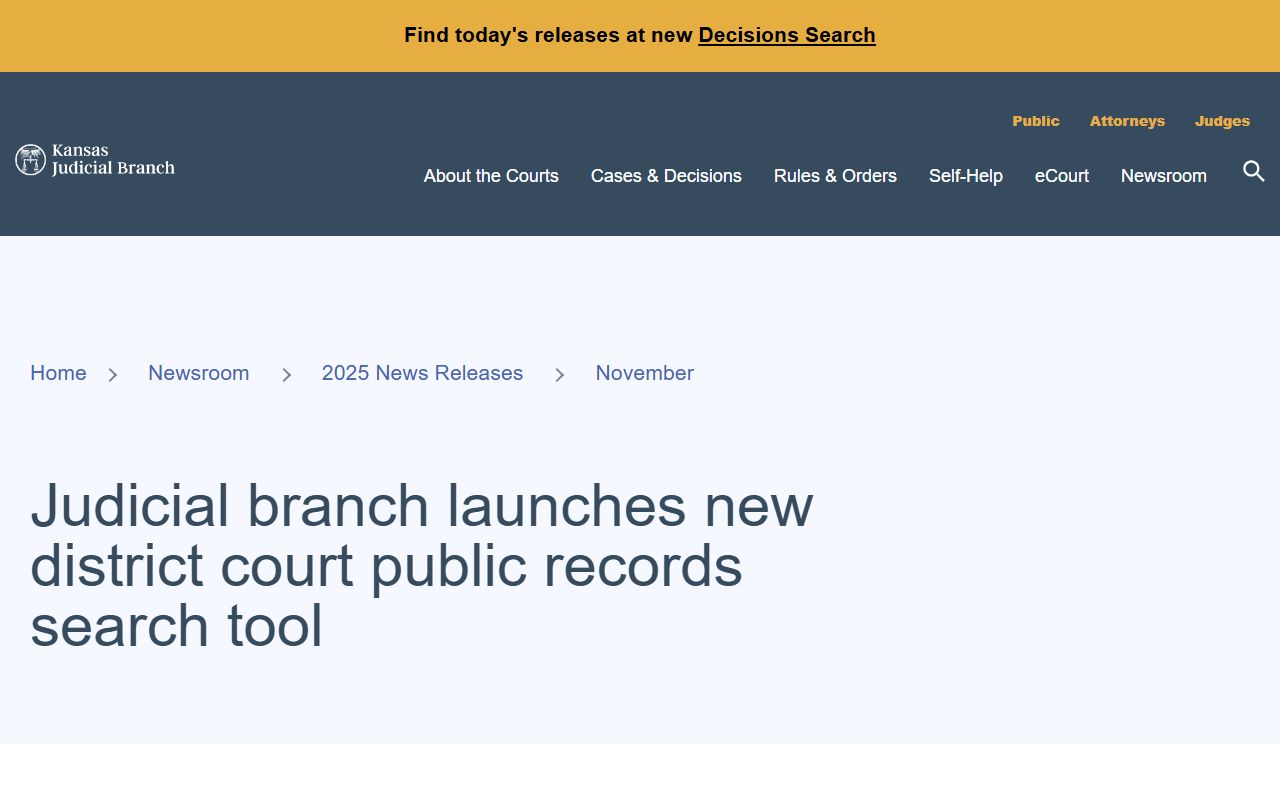
The portal view reinforces that online Smith County court records access flows through the statewide district court records system rather than a local county search page.
Types of Smith County Court Records
Smith County District Court is the general-jurisdiction trial court for the county. Its files may include civil petitions, criminal complaints or informations, domestic and divorce cases, probate estates, guardianships, conservatorships, small claims, juvenile matters that are not public, care-and-treatment matters, and traffic cases that belong in District Court. Public access is presumed for many records, but the record type controls what can be viewed, copied, redacted, or withheld.
Municipal court records are narrower. Smith Center Municipal Court handles city ordinance and municipal traffic matters, and the city provides a court schedule phone line at 785-282-3249. A municipal citation may not appear in the same way as a District Court case. For police contact tied to city matters, the Smith Center Police Department lists Chief Jamie Marshall at 117 1/2 W. Court, phone 785-282-6555, and email scpd@ruraltel.net.
- Civil court records can show petitions, answers, motions, orders, judgments, garnishments, liens, and satisfaction of judgment.
- Criminal court records can show filed charges, bond orders, first appearance, arraignment, motions, pleas, diversion, disposition, sentencing, restitution, probation, and later filings.
- Domestic records can include divorce petitions, temporary orders, parenting plans, child support worksheets, property orders, decrees, and post-decree motions.
- Probate records can include wills, estate petitions, inventories, creditor notices, orders, guardianship files, conservatorship files, and accountings.
- Traffic records can be District Court, Central Payment Center, or municipal records depending on the issuing agency and offense.
What Smith County Court Records Show
A court record is more than a name search result. It is a structured case file, and the docket is the chronological index inside that file. For a civil matter, the event list may track the petition, answer, motions, orders, judgment, and satisfaction. For a criminal matter, it may track charges, bond, hearings, plea, disposition, sentence, probation, restitution, and post-judgment activity. The field names below reflect the research inventory for Kansas district court records.
| Field | What It Shows |
|---|---|
| Case Number | The Kansas district court number assigned to the file. |
| Court | Smith County District Court and the 17th Judicial District when the case is local district court. |
| Case Title | Party caption, such as State of Kansas v. defendant or plaintiff v. defendant. |
| Party Names | Plaintiff, defendant, petitioner, respondent, decedent, guardian, conservator, or entity names where public. |
| Filing Date | Date the petition, complaint, charge, or other opening paper was filed. |
| Case Type | Criminal, civil, domestic, probate, juvenile, small claims, traffic, or another district court category. |
| Status | Open, pending, disposed, closed, dismissed, sealed, or restricted when displayed. |
| Docket / Events | Chronological entries for filings, hearings, notices, orders, judgments, warrants, disposition, sentencing, or appeal notices. |
| Financial Section | Fines, fees, restitution, court costs, bond, and payment status when exposed. |
| Documents | Public documents that may be viewable or downloadable when electronic access is allowed. |
The CourtListener legal opinion search is a related legal research source, not the Smith County case portal. It may help with legal opinions, but it does not replace CaseSearch or the local clerk for Smith County court records.
That distinction keeps legal research separate from the local record request path used for Smith County District Court case files.
Smith County Court Records Access Rules
Kansas public access starts with the open-records policy in Chapter 45 and the court-record rules that govern judicial files. K.S.A. 45-216 and 45-218 state the broad open-records policy and inspection rule. Kansas Supreme Court Rule 106 governs court files and records under court control. Kansas Supreme Court Rule 22 governs public electronic access to district and appellate case records.
K.S.A. 45-221 lists public records that agencies are not required to disclose, including records restricted by statute, federal law, or court rule. For Smith County court records, that means access can depend on whether the file is a court record, a county administrative record, a sheriff record, or a municipal record. The source and status of the record matter as much as the subject of the case.
The Kansas Open Records Act chapter index is the official statutory entry point for statewide open-records provisions. Smith County court records still follow court rules when the file is under judicial control.
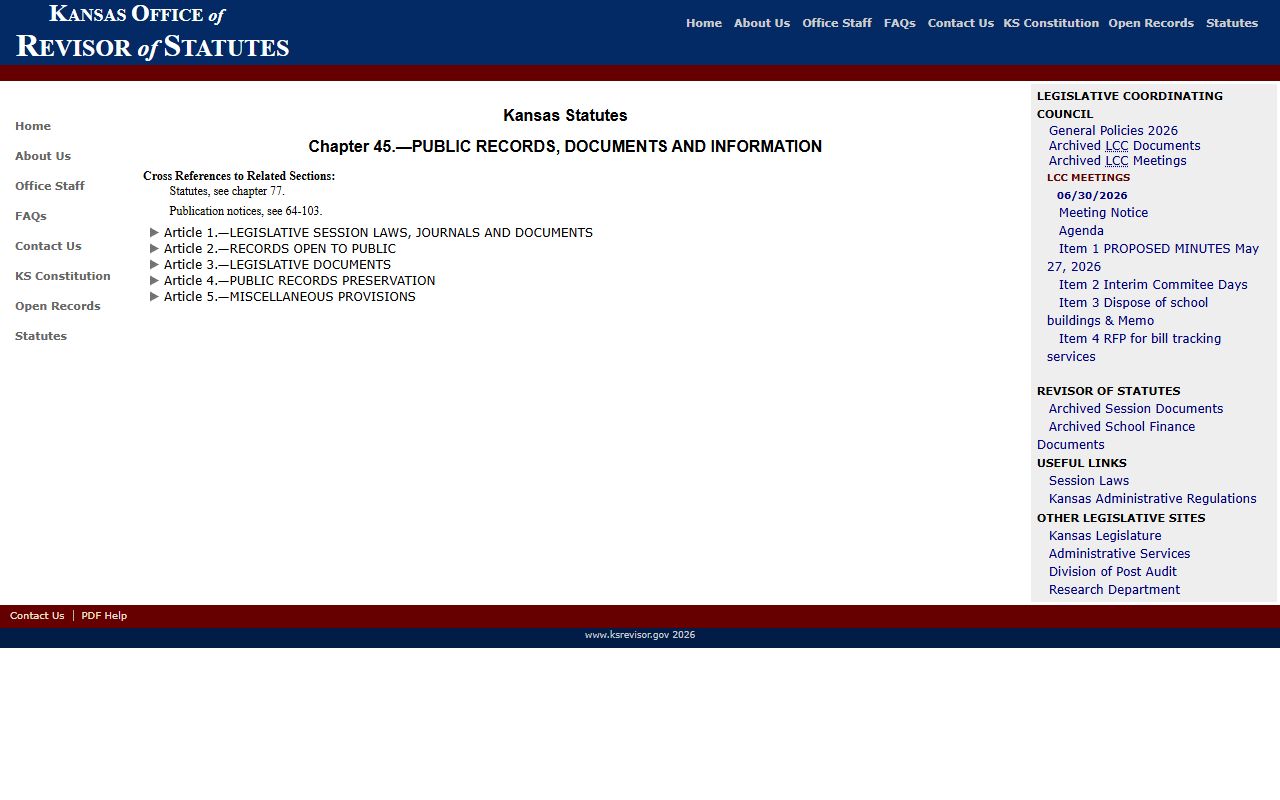
The open-records source is most useful when distinguishing court case files from non-court county agency records.
Note: Public access does not mean every document image, private identifier, juvenile file, or sealed record is open online.
Restricted Smith County Court Records
Several Smith County court record categories require care. Juvenile offender and child-related records are often restricted, and K.S.A. 38-2312 provides a juvenile expungement process. Adoption files are not ordinary open civil records. Mental health and care-and-treatment cases are sensitive. Protective-order files may be public in part, but personal identifiers and safety-related details can be redacted or withheld.
Sealing and redaction may also apply under K.S.A. 60-2617. A sealed record is not available to the general public unless access is later allowed by law or court order. Expungement can limit public access to qualifying adult convictions, arrest records, diversion agreements, and municipal matters, but the exact effect depends on the statute, case type, and order entered.
The official Kansas sealing and redaction statute is one of the key sources for understanding why a Smith County court records search may show no public entry even when a matter exists.
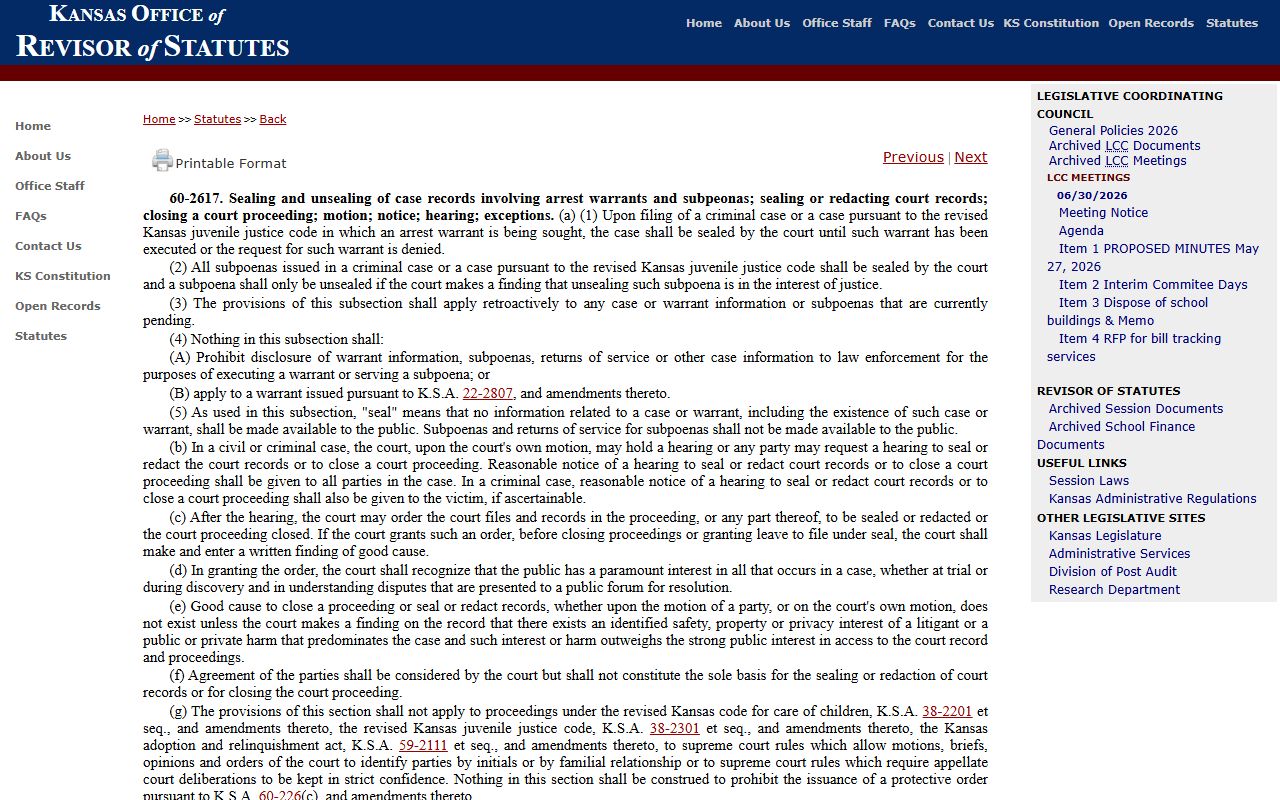
When a file is sealed, the practical next step is a clerk contact or a proper court request, not repeated public searching.
Smith County Court Record Requests
For certified copies, older files, paper records, or records not visible in CaseSearch, contact Smith County District Court at the Smith County Courthouse, 218 S Grant St., PO Box 273, Smith Center, KS 66967, phone 785-282-5140. The Clerk of the District Court is the court-record contact, while the Smith County Clerk handles county administrative records, elections, tax-roll work, and the county open-records form.
For non-court county records, the Smith County open-records channel uses the Request for Record Inspection/Copy form. The county fee page lists letter or legal size copies at $0.25 per page, oversize copies at $0.50 per page, fax sending or receiving at $0.25 per page, CDs at $25.00, and research or preparation time at $20.00 per hour or the employee's hourly rate, whichever is higher. The form states payment must be received on the day of request.
Clerk of the District Court
Smith County Courthouse
218 S Grant St., PO Box 273
Smith Center, KS 66967
785-282-5140
The Kansas public-record exemptions statute is the source to check when a county or court office separates open information from closed information.
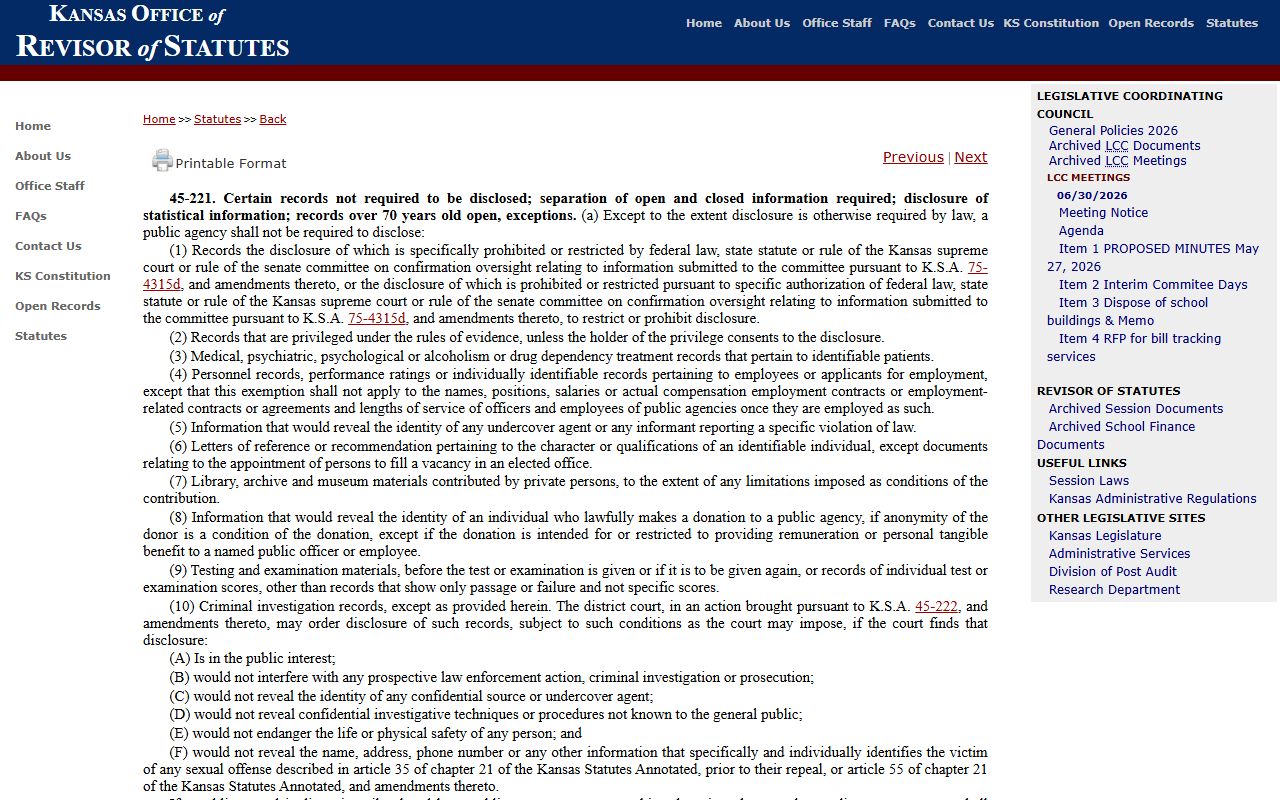
That separation rule explains why a clerk may provide part of a Smith County court record while withholding protected pages or identifiers.